At-Home Monitoring for Dogs and Cats with Heart Disease

Simple, practical steps owners can take each day — plus how technology may help you spot subtle changes sooner. This guide is written for pet owners and clinicians who want clear, evidence-based advice on monitoring congestive heart failure at home.

Why monitoring at home matters

Heart disease often changes slowly — and the earliest warning signs usually appear at home. Early detection lets your veterinarian intervene sooner, often avoiding emergency hospital visits and improving comfort and survival.

What owners usually miss

  • Slight, progressive increases in resting breathing rate over several days
  • Gradual reductions in daily activity or enthusiasm on walks
  • Minor changes in sleep pattern or night-time restlessness
  • Small, steady weight gain due to fluid retention

What monitoring helps with

  • Objective trends rather than single numbers
  • Early warning signs that prompt timely vet review
  • Easier communication with your clinic (share charts, not memories)

The 5 core things to track at home

Practical, easy metrics that owners can record. Not all are required for every dog or cat — your vet will advise which are most important for your pet.

1. Resting respiratory rate (SRR)

SRR is the most powerful and reproducible single metric for early detection of pulmonary congestion in both cats and dogs. Count breaths while the dog is in deep sleep for 30 seconds, and double it for a 'per minute' rate. Do this daily for a baseline over 7–14 days.

Tip: Record the time and the environment (bedroom, crate, living room). Aim for the same location each morning for consistent results. We recommend using an app designed for this purpose, such as the free 'Cardalis App'.
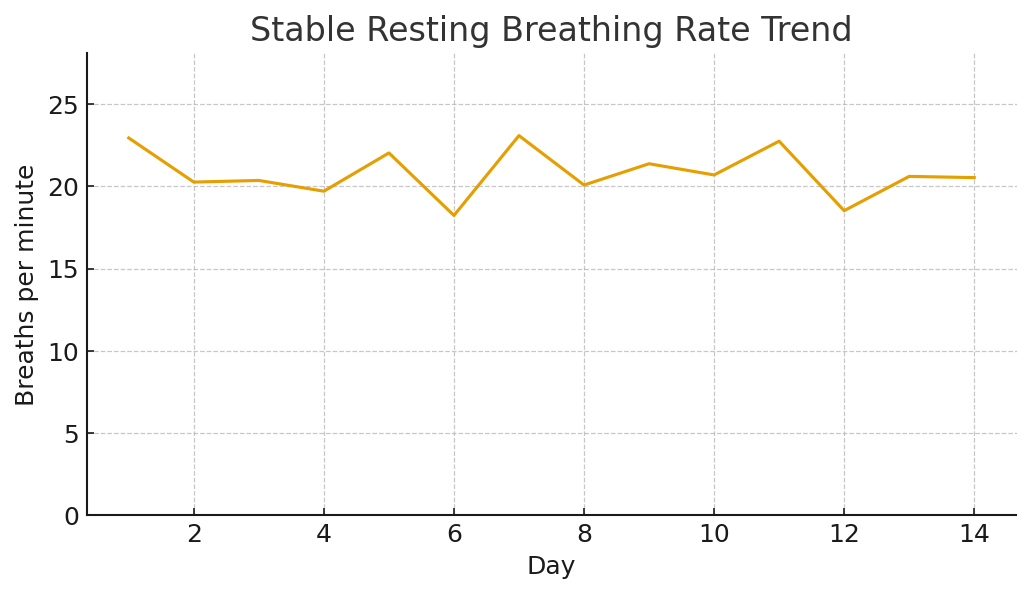
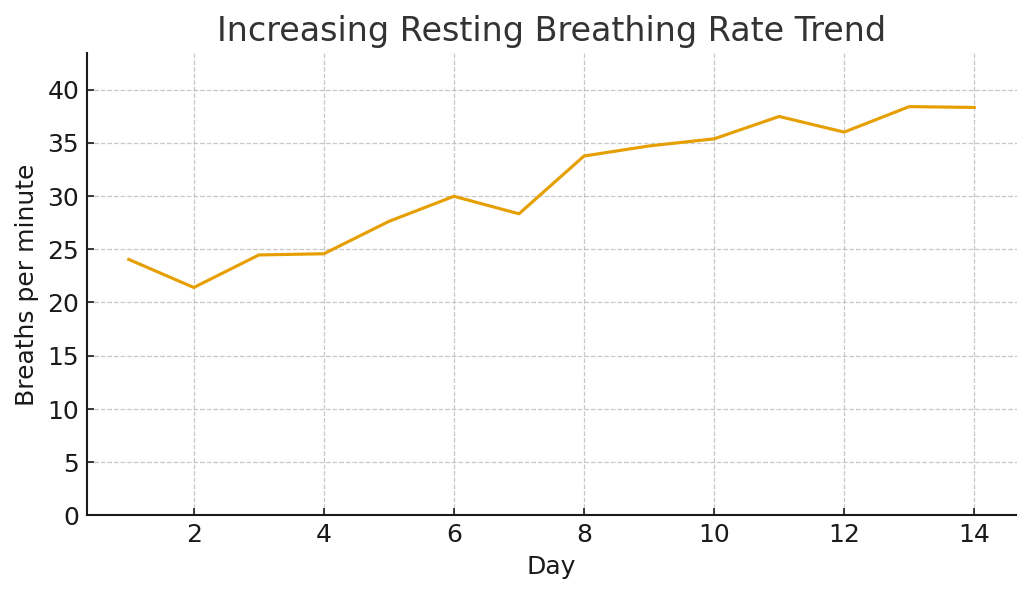
Graph of a stable breathing rate Graph of a rising breathing rate

Example: Stable SRR vs Rising SRR (trend)

Typical worry thresholds (general guidance): persistent SRR >30 breaths/min or a 20% rise from baseline over several days — contact your vet. Discuss what threshold to use with your vet - apps like the Cardalis App can set a custom threshold.

2. Breathing effort

Watch for open-mouth breathing, very deep chest/abdominal effort, or rapid gasping — these are serious signs and require urgent advice.

3. Activity & exercise tolerance

Note how far and how long your dog walks, how quickly they tire, and whether they pause on familiar routes. A drop in weekly activity of 20–30% is meaningful and worth reporting. This is much harder to judge in cats, and a tracking collar may be a good option for this. However clinical validation for this is still lacking.

4. Appetite, weight and general behaviour

Track appetite (normal / reduced / none), bodyweight trends (bathroom scale is fine for larger dogs, smaller dogs and cats I recommend getting a baby scale), and subtle behavioural changes (less play, hiding, pacing).

A small weight gain over days in a cat or dog with known heart disease may reflect fluid accumulation — discuss with your vet.

5. Coughing pattern

Record frequency, timing (night/morning/exercise), and character (moist/wet vs dry). Coughing can be cardiac or respiratory — further checks are often needed to differentiate. Cats rarely cough with heart disease.

How to measure SRR correctly (step-by-step)

  1. Wait until your pet is clearly asleep (deep sleep, lying on side or curled, eyes closed).
  2. Count visible breaths for 30 seconds — one rise + fall = one breath. Double this for a 'per minute' rate.
  3. Record the count and the time of day. Use the same conditions each time.
  4. Repeat nightly for 7–14 nights to build a baseline before relying on trends.

If you find manual counting difficult, consider one of the validated trend devices described below, using an app, or use a short phone video to count later.

Technology & trackers — what they can (and can’t) do

Wearables and apps can make monitoring easier by recording trends automatically. They are most useful for trend detection, not diagnosis.

What trackers help withWhat trackers cannot replace
Continuous activity trends, sleep/restlessness, automatic SRR logs (some devices)Chest X-rays, echocardiograms, ECG/Holter monitoring, professional clinical judgement
Objective graphs you can share with your vetReliable rhythm diagnosis — collars are not ECGs
Early alerts for gradual change over days/weeksImmediate clinical decision-making without vet review

Devices to be aware of

A few consumer devices have published validation for specific metrics (e.g., resting respiratory rate). Examples include Maven, Invoxia and PetPace — each has strengths and limitations. Use device output as ancillary information and discuss abnormalities with your vet.

Click here for our full guide to tracking collars
Important: Validation in healthy dogs does not guarantee identical performance in dogs with heart or lung disease. Always interpret trends with clinical context. We are still looking for evidence of validation in cats as well.

When to contact your vet (practical guidance)

Not every change requires an emergency visit. Use these practical thresholds to decide when to call.

Urgent — call immediately
  • Marked difficulty breathing, open-mouth breathing or gasping
  • SRR > 40 breaths/min and not settling
  • Collapse or severe lethargy
  • Blue or very pale gums
Contact your vet within 24 hours
  • Persistent SRR rise over baseline (20%+ over several days)
  • Progressive reduction in activity / appetite
  • Unexplained weight gain over days

Free downloads & quick tools

Use these printable resources to make monitoring easy.

This guide is for educational purposes only. Always follow the advice of your veterinarian for clinical decision-making.