
If your dog has just been diagnosed with a heart murmur, the first thing worth knowing is that a murmur is a sound, not a diagnosis. Let's take a deeper look into what murmurs are, what causes them, and what to do next.
What is a heart murmur?
A heart murmur is an abnormal sound heard during a veterinary examination, typically with a stethoscope. Normally, a dog’s heart sounds like a steady ‘lub-dub, lub-dub.’ But when there’s a heart murmur, you’ll hear a whooshing or swishing sound instead.
So, what causes a heart murmur?
The cause is typically turbulent blood flow in the heart. Imagine a fast-moving river that flows quietly until it reaches a constriction, such as a bridge or rapids. That constriction causes the water to become noisy and chaotic. The same principle applies to blood flow inside your dog’s heart. When blood flow becomes turbulent due to an issue like a leaky valve or narrowing of a vessel, it creates sound waves that we hear as a murmur.
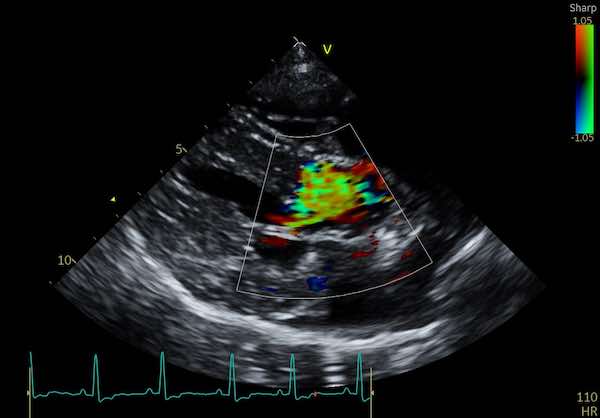
Image: Turbulent flow on colour doppler interrogation of a dog's aorta
What causes heart murmurs?
There are various reasons why your dog might have a heart murmur:
- Innocent murmurs. Harmless, and common in puppies. Most of them disappear as the puppy grows.
- Flow murmurs. Found in young, athletic dogs, particularly when they are stressed at the vet.
- Underlying heart disease. Some murmurs do point to a real problem:
- Congenital heart defects: Some dogs are born with abnormal heart structures.
- Leaky heart valves: Common in older dogs, particularly small breeds like Cavalier King Charles Spaniels and Chihuahuas.
- Heart muscle disease: Larger breeds like Dobermans may develop conditions like dilated cardiomyopathy.
- Other conditions: Issues such as anaemia or infections can also contribute to murmurs.
Symptoms to watch for
A heart murmur itself doesn’t always mean your dog has heart disease, but it can be an early sign. Murmurs are often discovered before any other symptoms show, which is fortunate because heart conditions can be treated more effectively when caught early.
If your dog has a murmur, watch for the signs that suggest something more serious:
- Coughing, especially at night or after exercise
- Lethargy, or doing less than they used to
- Fast or laboured breathing, particularly a sleeping respiratory rate over 30 breaths per minute
- Fainting or collapse
- Loss of appetite or weight
One key measurement is your dog’s sleeping respiratory rate. I’ll have a detailed guide on how to monitor this in the description below.
Diagnosing heart murmurs
When a murmur is detected, the next step is determining how serious it is. Your vet may recommend the following diagnostic tests:
🩺 Echocardiogram (echo): An ultrasound scan of the heart, and the best way to see how well it is actually working.
🩻 Chest X-rays: To check the size of the heart and assess lung health.
🩸 Blood tests: To rule out other potential health issues and screen for conditions that could affect heart health.
⚡ ECG for rhythm disturbances: If your vet suspects irregular heartbeats.
An echocardiogram is typically the most informative test and provides detailed images of the heart’s structure and function.
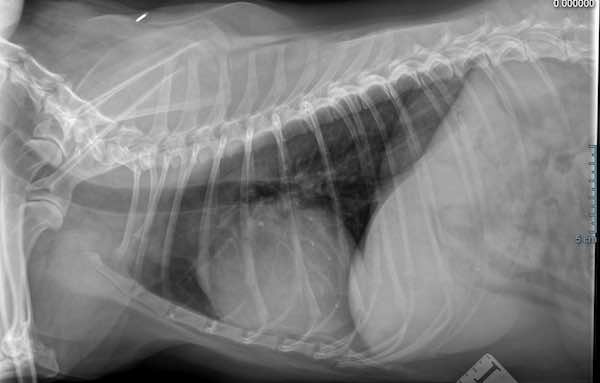
On a chest radiograph (or X-ray) the heart appears in silhouette only.
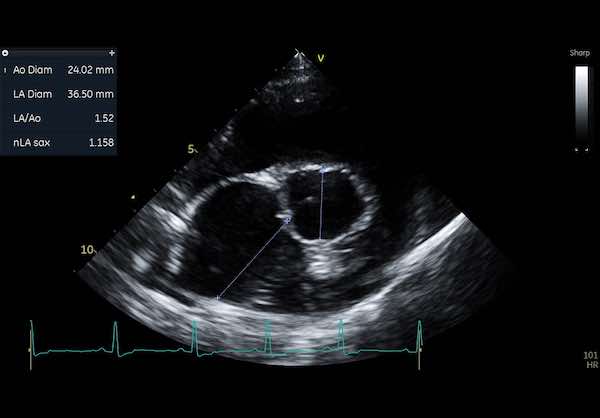
While on an echocardiogram you can measure all the internal chamber sizes to fractions of a millimetre.
Treatment and management
Not all heart murmurs require treatment, but if the murmur is linked to an underlying condition, your dog may need medication. Some common treatments include:
💊 Pimobendan: A medication that boosts the heart’s pumping function, delaying further heart deterioration.
💊 Diuretics: These reduce fluid buildup in the lungs and are often used in cases of congestive heart failure.
💊 ACE inhibitors: Help blood flow more easily and reduce harmful changes to the heart’s structure.
🩻 In some areas, surgical interventions, such as catheter techniques and even open-heart surgery, are available to treat conditions like heart valve diseases.
If your dog has a murmur, talk to your vet about what monitoring makes sense and whether any treatment is needed yet.
What you can do at home
If your dog has a heart murmur, there are a few things worth doing:
- Follow your vet’s advice on diagnosis and monitoring.
- Ask for an echocardiogram, done by someone who scans hearts regularly.
- Keep up with the check-ups and screening.
- Track the sleeping respiratory rate, and keep an eye on energy levels.
- Keep the weight sensible and the diet balanced.
None of that is dramatic, but it is what lets your vet catch a change in the heart while there is still time to do something about it.
The thing to hold on to
A murmur sounds alarming, and for a lot of dogs it turns out to mean very little. Plenty live long lives with one. What changes the outcome is finding out early which kind you are dealing with, and then keeping an eye on it.
If you have a question about your dog’s heart, leave a comment below.
Check out my video on the same topic if you want a more in depth explanation: